Showing posts with label Bradley Family. Show all posts

Mar 4, 2012

Emma V Bradley

Emma Varnera Bradley, born at Kalamo, Eaton County, Michigan on October 13, 1845, was the youngest daughter of James D. and Tirzah (Lankton) Bradley.

Emma's young life seems more eventful that most, given the sensational murder trial of her sister when Emma was just 11 years old. Her father died when she was 12.  In 1860, she lived at the farm with her brother, Truman, his wife Abigail, her mother and her aunt Hannah Lankton.

1860 U.S. Federal Census, Kalamo, Eaton, Michigan

In 1862, Emma's sister-in-law, just a few months older than Emma, died during childbirth. 

Emma married Robert Andrews of Oswego, New York on April 5, 1864 at her home in Kalamo. Emma and Robert moved to Robert's childhood home on a farm in Southwest Oswego, New York where their first daughter, Lucy Estella, was born on April 26, 1866. They had a second daughter, Clara Augustus, on  November 15, 1868 and a son, William Bradley Andrews on November 16, 1870.

The family was well known in the community and were active members of the Hope Grange and the Southwest Oswego Baptist Church. 

Thanks to "Old Fulton Postcards," I've been able to piece together a "snap shot" of Emma's life in Oswego.

On January 1st, 1890, the family had a New Year's Eve party!
OSWEGO DAILY TIMES JANUARY 1 1890
SOUTHWEST OSWEGO
Jan 1.-Last evening a large number of young people met at the residence of Mr. Robert Andrews. The time was spent in playing games and singing. Lunch was served at 11 o'clock, followed by popcorn and peanuts. At two o'clock the party broke up realizing that they had not been home since last year.

In September 1894, Her brother Ira D. Bradley came to New York for a visit:
OSWEGO DAILY TIMES, WEDNESDAY SEPTEMBER 5, 1894
Southwest Oswego
Sept. 3
Mrs. Robert Andrews is entertaining her eldest brother from Michigan.-
Emma and Lucy took a trip to Michigan in 1895. Apparently, Clara and William didn't go along.

OSWEGO DAILY TIMES FRIDAY AUGUST 16, 1895
Robert Andrews wife and daughter Lucy started for Michigan today.
They hosted a social in 1898:

OSWEGO DAILY TIMES OCTOBER 10, 1898
SOUTHWEST OSWEGO
OCT 10- On Friday evening of this week the Y.P.S.C.E. will hold a pumpkin pie social at the home of Mr. Robert Andrews.
In 1899, Clara married S. Franklin Lewis at the home of her parents. Sounds like a beautiful gown she wore. The Wedding March was played by Clara's cousin, Miss Elizabeth Andrews. I thought Clara's father was an only child, but if Elizabeth is Clara's first cousin, he must have had a brother.  Emma's brother Truman died in Feb. 1899. I wonder if she went to Michigan at that time, but I didn't find a notice.

OSWEGO DAILY TIMES JUNE 27, 1899
Lewis-Andrews
A very pretty home wedding occurred at Southwest Oswego Wednesday evening, June 14, when Clara Augusta, second daughter of Mr. Robert Andrews, was married to Mr. Franklin Lewis of Fruit Valley. The bride was attended by her friend, Miss Cora Vodra, while William, brother of the bride, acted as best man.  At eight o'clock Miss Elizabeth Andrews, cousin of the bride, played Mendelsaohn's wedding march and the bridal party descended to the parlors where the Rev. A.H. Sutphin performed the ceremony.
The bride wore a gown of white cashmere and white satin and wore white bride's roses, the bridesmaid white organdie and pink roses. The parlors were beautifully trimmed with ferns, roses and daisies. After the ceremony and elaborate wedding supper was served.
Guests were present from Oswego, Scriba, Volney and Sterling. Mr. and Mrs. Lewis will reside near Fruit Valley and their many friends wish them a long and happy future.
 Later that year, they held another social for the church youth. Lucy was a school teacher, and a Sunday School teacher, so maybe these were her parties.

THE OSWEGO DAILY PALLADIUM: WEDNESDAY EVENING, NOVEMBER 22, 1899
OSWEGO TOWN
The young people of the Baptist church will hold a social at the home of Robert Andrews on Friday evening December 1st.
 Emma and Lucy visited the Pan American in October 1901

OSWEGO DAILY TIMES, MONDAY EVENING, OCTOBER 21, 1901
SOUTHWEST OSWEGO
OCT.21- Mrs. Robert Andrews and daughter, Lucy, visited the Pan-American last Saturday.

Birdseye view of the Pan-American exposition, Buffalo, May 1 to November 1, 1901

  • Digital ID: (digital file from original print) ppmsca 07832 http://hdl.loc.gov/loc.pnp/ppmsca.07832
  • Reproduction Number: LC-DIG-ppmsca-07832 (digital file from original print) LC-USZ62-23777 (b&w film copy neg.)
  • Repository: Library of Congress Prints and Photographs Division Washington, D.C. 20540 USA


The Pan American was a world's fair held in Buffalo NY in 1901. 

More visitors from Michigan in November 1901.
Oswego Daily Times, Wednesday Evening, November 13, 1901
SOUTHWEST OSWEGO
Nov. 13 - Mrs. Lura Thornton and Mr. Ira Bradley of Ainger, Mich., are visiting their sister, Mrs. Robert Andrews.
 Several mentions in August 1905, including another visit from Emma's sister, Lury. I wonder about Lucy's relatives in New York City.

OSWEGO DAILY TIMES, TUESDAY EVENING AUGUST 15, 1905
Southwest Oswego Aug. 14-
Miss Lucy Andrews is visiting relatives in New York City.
Mrs. Jennie Baldwin of Fulton is the guest of Mrs. Clara Lewis.
Mrs. Lucy Thornton of Ainger, Mich. is visiting her sister Mrs. Robert Andrews.


Quite a bit going on around Lucy's marriage to Mr. H.E. Kingsley on Aug 8, 1906.
OSWEGO DAILY TIMES, THURSDAY EVENING, AUGUST 9, 1906
OSWEGO CENTER
Miss Jennie Daly gave a shower this afternoon at her home at Southwest Oswego in honor of Miss Lucy Andrews, who will be married this week Wednesday.
KINGLSEY-ANDREWS
Popular Teacher of Oswego Town Wedded to Syracuse Man
SOUTHWEST OSWEGO, August 9-
A quiet but pretty house wedding occurred at the home of Mr. and Mrs. Robert Andrews of this place Wednesday, August 8, when their daughter, Lucy Estella, was united in marriage ot Mr. Herbert Eugene Kingsly of Syracuse, the Rev. G.A. Fairbank officiating.
The house was prettily decorated with evergreen and flowers, Miss Marcia Pease playing the wedding march. The bride was tastefully gowned in a traveling dress of brown silk and carried white sweet peas. The wedding presents were numerous and elegant and included two hansome pieces of silver from the Southwest Oswego Baptist Church of which the bride was a member, also a peice of hand-painted china fromher Sunday School class. She is a well-known teacher of Oswego Town, popular in social work and much esteemed by all.
After a short sojourn among the Islands Mr. and Mrs. Kingsley will be at home to their friends at 129 Purple Street, Syracuse.
OSWEGO DAILY TIMES, August 14, 1906
SOUTHWEST OSWEGO
Aug 14--Mr. and Mrs. A Campbell and Mrs. Lura Thornton of Ainger, Mich. are visiting their sister, Mrs. Robert Andrews
OSWEGO DAILY TIMES AUGUST 18, 1906
SOUTHWEST OSWEGO
August 18.-- Mr and Mrs G.A. Campbell and Mrs. Lury A Thornton of Charlotte Michigan, who have been visiting at the home of Robert Andrews and who called there to attend the wedding of his daughter, returned to their home yesterday.
 In 1908, Emma lost her husband on March 26th, then her brother, Ira, on July 21. Emma was Ill at the beginning of December, and died at home on Wednesday, December 16, 1908.

OSWEGO DAILY TIMES DECEMBER 21 1908
SOUTHWEST OSWEGO
Mrs. Emma Andrews, widow of the late Robert Andrews, died at the family home in this town Wednesday Dec. 16, after an illness of 15 days. She leaves one son, William, of this town, and two daughters, Mrs. H.E. Kingsley, of Syracuse, and Mrs. S.F. Lewis of Fruit Valley, also two sisters, Mrs. Lura Thornton and Mrs. Sarah Campbell, of Bellevue, Mich.
Mrs. Andrews was a member of the Baptist Church and also of Hope Grange. The funeral was held Friday, Internment at Rural Cemetery.- Mrs. Sarah Campbell, of Bellevue, Mich. and Mrs. Jennie Baldwin, of Fulton, N.Y., are in town, called here by the death of Mrs. Andrews.


Mar 1, 2012

Death of Robert Andrews


Here is the obituary for Robert Andrews, the husband of James D. Bradley's youngest daughter, Emma Varnera Bradley. It was the first of many articles I found about the family at Old Fulton NY Post Cards. It was an exciting find for me, as I knew nothing beyond names and dates for Emma. She was the only one of the Bradley's 10 children born at Kalamo, Eaton Co., Michigan, the rest born in New York.
Obituary
Mr. Robert Andrews
    Died at his home one mile West of Southwest Oswego one of Oswego Town's well know and highly respected citizens, Robert Andrews, aged 68 years 11 months and 21 days. Mr. Andrews had lived during his whole life in the same school district having been born on a farm adjacent to the present homestead to which he moved with his parents when about four years of age. On April fifth 1864 he was united in marriage to Miss Emma V. Bradley of Kalamo, Eaton Co., Michigan; and she with their three children, Mrs. H.E. Kingsley, Mrs. S.F. Lewis, and William B. Andrews still survive him. He was a kind and sympathatic husband and fater and a great lover of home and family.
    Although he had been in poor health for years, and death was not unexpected, the end was sudden and a great shock to his friends, yet he pass- ed away so peacefully that they scarcely knew when the spirit took its flight.
    He was much interested in the political affairs of the country and town as a Republican, but did not de- sire official positions, yet he had vot- ed at every election after he became of age.
   He had been a faithful attendant of the S.W. Oswego Baptist Church since its organization, and later be- came one of its esteemed members, since which time he has been deeply interested in its welfare, and has con- scientiously supported its workings in all ways acting as trustee for a num- ber of years.
   The large number who attended his funeral at the home church on March 29, notwithstanding the bad condition of the roads, told of the high respect and esteem in which he was held.
   "Mark the perfect man and behold the upright; for the end of that man is peace."

CARD OF THANKS
South West Oswego, April 1 -
We wish to express our sincere thanks to our neighbors and friends for their kindness and sympathy during the short sickness and burial of our dear husband and father. Also to the Baptist Curch and Hope Grange and others for the beautiful flowers given at this time of our great bereavement.
Mrs. Emma V. Andrews,
William B. Andrews,
Mr and Mrs H.E. Kingsley,
Mr and Mrs S.F. Lewis
(Oswego Daily Times, Thursday Evening April 2, 1908)


I would like to know what brought Robert to Eaton County. He was listed in both the 1850 and 1860 census' living with his parents, Samuel and Mary Andrews at Oswego, New York. His father having been born in Ireland. He was the only child (11 years old) in 1850. In 1860, there was also a 12 year old girl named Jane Hines.


There were a number of Andrews' families living in Eaton County in 1860, but none that I can so far connect to Robert. Perhaps he knew one of Emma's brothers through Grange business?

Feb 27, 2012

Double Wedding at Charlotte

DOUBLE WEDDING AT CHARLOTTE
Popular Young People Living South of 
City are Wedded -- Best Man
Becomes Groom
 Charlotte, Mich., May 1.-- Rev. S.C.Hall had the honor of officiating at a double wedding Sunday, the ceremony taking place at his residence in this city. George M. Bradley and Miss Bessie M. Mellor, two popular young people from south of the city were first united in marriage. Wayne C. Bradley, a cousin of the groom, and Miss Leurena Weeks, a chum of the bride, standing up with them.
Immediately after this ceremony the latter two were united in marriage, the newly married Mr. and Mrs. George Bradley acting as best man and bridesmaid. The two couples will reside in Walton township.
(Kalamazoo Gazette-05-02-1911, p.2)

Another fun story about some fellow descendants of James D. Bradley. To me, these newspaper articles give life to the names, dates and charts. Both George and Wayne are Grandsons of Ira D. Bradley, son of James D. Bradley. 


Feb 26, 2012

Old Newspapers

I accidently bought a subscription to GenealogyBank.com last week. A blogger I follow mentioned that she got a 1 month trial, so I clicked and signed up... not realizing that the trial was 10 bucks! My fault, I just whipped through the registration assuming it was free.

Had I known, I would have bookmarked to investigate later, when I could maybe justify the spending. But I'm really glad I didn't know! 15 minutes would have been worth more than 10 dollars to me! I love reading old newspapers. They reported everything from visitors and family picnics to legal problems and obituaries. Fultonhistory.com makes a lot of New York papers searchable and available for free.

Here's an interesting story I found about my 6th cousin, 6x removed, the grandson of my 3rd Great Grandfather, James Dickinson Bradley.

Ira D Bradley was about 20 years old when he came to Eaton County Michigan with his parents and siblings in about 1841. Five years later, he married Aseneth Jane Day (the daughter of Asa Day,) and they had 5 sons. His fourth son, Andrew Jackson Bradley, married Hattie Roscoe on March 16, 1880 at Walton, Eaton County, Michigan.

That's all I knew about Andrew, except that he died Oct. 24, 1898 in Battle Creek and was buried at Olivet Cemetery where his parents are buried. Andrew and Hattie never had children.

And then I found this:

HIS DIVORCED WIFE
Dying Battle Creek Man Left Her $1,000 to
"Increase Happiness"
BATTLE CREEK, Oct. 25 - A queer case of the affection of a man for a divorced wife was revealed here by the death of Andrew Bradley, aged 38, last night at the Nichols hospital. Bradley had been divorced and his wife had married another man. He had no children and lived at a boarding-house. He was taken sick there with typhoid fever and was conveyed by Battle Creek camp of Modern Woodmen to the hospital.
His policy in the Woodmen was made to his divorced wife. He said that he still loved her, and although the wife of another man he desired to increase her happiness and comfort by leaving her $1,000. This is the only case on record of the kind.
(Kalamazoo Gazette, Oct 26, 1898, p.1)

What a sad story. I know it's him because his death certificate says he divorced, and died of Typhoid Fever in Battle Creek on Oct 24, 1898.

I don't know when they divorced, but Hattie married Joel L Marble just 3 months before Andrew died.

By 1900, she was divorced again and living with her father, John Roscoe.

She married for a third time, later in 1900, to Henry M Baker and he died in 1902.


The "Modern Woodmen" was (and is) a fraternal organization that protected families following the death of a breadwinner.

Sep 7, 2011

He Wooed her in a Prison - A Mary H. Bradley Brooks Stewart Story, Part 2

Read part one here.

Although, by local accounts, Mary Brooks was accidently not sentenced to solitary confinement, she is listed as having been sentenced to solitary confinement in the "Annual report of the inspectors of the State Prison of the State of Michigan ... By Michigan State Prison, 1862,"


So, Judge Pratt was evidently able to correct his ommision. Mary is the only female listed, and likely the first female ever confined at the Jackson prison since they built the women's ward in 1856. The solitary cells were added in 1857. Since Michigan abolished the death penalty in 1847, the harshest sentence was life in solitary confinement. Also, in the 1862 annual report, the inspectors related their opinion of solitary confinement:


In 1861, the law was modified so that the inspectors could, at their discrecion, release a prisoner from solitary confinement.


It appears that Mary was never actually put in solitary confinement, but assigned to work as a cook in the new women's prison. A prison officer related that they would not have executed the sentence, "that she was too good a woman for such a doom."

Old Jackson State Prison
Photo Credit: Jackson District Library


Mary's first "sweetheart," David Stewart, became a regular visitor to the prison. After several years, he became well known to the other prisoners and staff and became a "local tradition." David started a petition to secure a pardon, but that failed. Feeling hopeless and wishing for David's happiness, Mary implored him to marry another. Before 1860, David married Elizabeth, but continued to visit Mary, apparently with Elizabeth's blessing.


**Note: It seems that some journalists in the 1800's were just as prone to fact altering sensationalism as they are today! Ahh, the good old days! I'm assuming/hoping that the bottom line is true, otherwise, it would not have been a story. I've indicated the nonfactual parts with red text.

The News, Providence R.I. September 21, 1899, pg 6


David Stewart showed up at the secret inquisition, volunteering information that Mary stole his arsenic. He wasn't the only one, though. Apparently, Van Arman thought Mr. Mann's  claim that she stole it from him was more credible. There is no indication that David actually testified. Also, Mary did not "Testify That She Poisoned Her Husband."

Since the death sentence was abolished in Michigan some 9 years prior, the "SENTENCE OF DEATH PRONOUNCE" ... false.

Her sentence was never "Commuted to Life," but it certainly seems true that "Later Stewart Had a Change of Heart!"


     Charlotte, Mich., Sept. 21 - Wedded in the evening of their lives, Mary Brooks and David H. Stewart look back with dim, tranquil eyes to the dark morning time, when she stood in the shadow of the gallows, dragged thither by him, her sweetheart, and accuser. Their hair is white now, and the evening promises fair. 
     They were sweethearts half a century ago. There is not much to tell about that part of it and if one of them had not been faithless there would be nothing at all to tell.
     The faithless one was Mary Bradley --for that was her maiden name. In 1852, when she was 21 years old, her parents persuaded her to jilt David Stewart and marry a crabbed old farmer, whose broad acres made him worthy in their eyes.
     Here too, the story might end like many another, if Simon Brooks had not died, and from poison. That was three years after his marriage, and all the countryside knew that Mary Brooks had not put an end to all fondness for her old sweetheart.
      It was he who fastened the crime of murder upon her. Quite uninvited, he came forward at the inquest and denounced the woman he loved. Pointing his finger at her he exclaimed: 
"She saw a bottle of arsenic in my room and asked me to give it to her. I refused. A little later I missed the bottle. Search the murdered man's house and you will find it!"
     They searched, and the empty bottle was found.


(as Van Arman said after the trial in part one, they never proved that Mary even had arsenic, let alone stolen arsenic. I would take that to mean that an empty bottle was not found.)


     The trial of Mary Brooks, accused by the man for whom she had stooped to the crime, was the great sensation of the time in that unsettled country. 
     Its effect was intensified by the extraordinary action of her advocate, the brilliant Van Arman, who closed his plea by swallowing two tablets of the same drug that Stewart's bottle had contained in order to convince the jury that it could not have caused to old farmer's death.
     It was done without a moment's warning. The court was a tumult at once. Judge Pratt announced an adjournment and sent for doctors. Van Arnam folded his arms and waved aside those who proffered help.
     He did not die, but the risk he had run was of no avail. Mary Brooks was convicted and sentenced to be hanged.  Because of her sex the sentence was commuted to imprisonment for life, and she was sent to the new prison at Jackson, the first woman to be received there.
    She was resigned, obedient, industrious. When she spoke it was to assert her innocence. The deputy warden of that day now the Hon. William L. Seaton, had a cell built apart for her accommodation since the plan of the prison included no provision for women.
    She was not without friends, and --- marvelous to relate--- the staunchest of these was David Stewart.
     Nobody ever quite understood his motive, but he gave every evidence of sorrow for the part he had taken in his sweetheart's condemnation and sought to atone for it by agitation for her release. His own signature stood as the head of a petition for that end which was circulated throughout the state.


(As noted earlier, although Van Arman was famous for "The Arsenic Incident," it didn't happen in this trial. Also, he was not her advocate, but the prosecuting attorney.)


     It was strange and touching--that second courtship in jail. Imprisonment softened Mary Brook's character, and Stewart fell in love with her all over again.
     The petition was not successful, and these two sweethearts grew old with the walls of a jail dividing them. In course of time the romance ceased to amaze the inhabitants and became merely and existing local tradition.
     That they should ever be united seemed hopeless. Mary Brooks entreated Stewart to marry some other woman. She said that it would make her happy. He did marry, but he did not cease to visit the prisoner in jail.
     Mary Brooks was pardoned twenty years ago. She was faded but still handsome. From her relatives, who were well-to-do, she inherited a home and a comfortable little fortune. Her life after that was a very quiet one, devoted to deeds of kindness.
     She and the Stewart's were neighbors in the little hamlet of Kalamo, Eaton county--neighbors and friends. Mr. Stewart's wife knew all about the old romance, and thought non the worse of her husband for it, or of Mary Brooks. Whoever believed the woman to have been guilty also believed that she had made atonement.
     Stewart's wife died a few years ago. He was an old man then, and Mary Brooks was an old woman. There was a third courtship, this time in an environment of smiling fields and gardens--for each had a beautiful country home.
     The fruit of that autumnal courtship was a quiet wedding Monday at Mrs. Brooks home. She is 68, and her bridegroom three years older. The shadow of the gallows is far behind them.
     
This article ran in "The News," Providence R.I. on September 21, 1899. A similar article, "Pardoned Murderess Weds, " ran in the New York Times on September 20, 1899, with mostly the same misinformation. My guess is that the story was picked up from a Charlotte newspaper, maybe relating the story upon David's death in 1899.

Mary was pardoned on February 12, 1870.


Interesting that the prosecuting attorney, John Van Arman, recommended the pardon. He previously stated that, had he defended her, she would not have been convicted. Even more interesting... "upon proof tending to show that some person other than the prisoner was the real instigator of the crime committed."  I REALLY wonder who that was! Especially, since it may have been a death bed confession!


Mary is enumerated in the home of her sister's family, LuryAnn and Archelaus Thornton, in the June 1870 Federal Census. Mary's Father, a farmer, died just a year after Mary's conviction. Her Mother, Tirzah, was still living on the farm, along with Tirzah's sister, Hannah Lankton, Mary's brother Truman, his wife, Sarah and several of their children. Her brothers Ira and Joe were also farmers, so between them all, they owned quite a bit of land, but wouldn't necessarily be "well-to-do." Mary probably did not "inherit a small fortune." It is possible that a separate home was built on her sister's land. They were neighbors of David and Elizabeth Stewart.

Elizabeth and David never had children and Elizabeth died on May 22, 1877, aged 57 years.

David H. Stewart and Mary H. Bradley Brooks married on August 25th, 1877 by Elder Sloan, witnessed by her brothers-in-law, George Campbell and Archelaus Thornton. Mary was 44 years old, and David was 56.

On August 21, 1899, just 4 days shy of the 22nd anniversary of of their marriage, David H. Stewart, born to Jacob and Phoebe Stewart at Sparta, Livingston, New York about March 20, 1820, died from bronchitis at age 79 years, 5 months and 1  day. 

He was buried at West Carmel Cemetery alongside his first wife, Elizabeth.

In 1900, Mary was back living with her sister, Lury Bradley Thronton, nephew, Gilbert Thornton and his family. Mary died 4 years and 9 months after her husband, on May 13th, 1905, at age 73. She is buried alongside David and Elizabeth at West Carmel Cemetery.

*** Interesting notes: The official reporter on David's death record is Arthur J Day, the son of Lury Woolcutt Day, whom I suspect is Mary's cousin (still trying to prove that though.)

*** There were some land transfers between James D. Bradley and Simeon P Brooks. Also, some land transfers between James D Bradley (Mary's father) and Martin Brackett (Mary's attorney,) possibly for payment?

*** Other than the land transfers, there doesn't seem to be any more information about Simeon Brooks. He is not listed in any Eaton Co., Mi census and I can't find a death or burial record for him or his daughter Edith. The Bradley's were neighbors of a divorced woman, Tina Brooks, but I can't find a connection there. He may have been a relative of Nathan, Aaron or Silas Brooks who were early settlers in Kalamo. Mary's brother, Joseph, was married to Fannie Melissa Brooks, a daughter of Zimri Brooks and Grand-daughter of Silas Brooks.

Just recently, I ran across a note in my Grandmother's stuff, but she didn't seem to pursue the story. I wonder why...


Aug 27, 2011

Murder Trial in Charlotte, Michigan - A Story of Mary H. Bradley Brooks Stewart - (Part 1)

I've been intrigued / obsessed with the story of my 2nd Great Aunt, Mary Bradley, since discovering this post back in 2002. Mary's story was a well-kept family secret. Here's what I have learned so far: Mary H. Bradley was born on April 24th, 18321 at Whitestown, Oneida Co., New York, the 6th child (4th living) of James D. and Tirzah (Lankton) Bradley. Sometime around 1841, when Mary was about 8 years old, the family emigrated to Kalamo, Eaton Co., MI. If Mary attended school, she didn't learn to write well, judging from her letters to her best friend, Watson Woodruff. As a young woman of 17 or 18, Mary intended to marry her "sweetheart," David Harrison Stewart, but gave in to her parents wish to marry Simeon Brooks, a much older wealthy land owner2. They were married on April 1st, 18513.


Mary had a daughter named Edith4. Edith and Simeon both got sick and were attended to by Dr. H.T. Fero, who, although not a "regular physician," attended to the sick. The doctor was also a Baptist minister, as well as the postmaster in Bellevue. The little girl died, followed by her father a few months later. According to Mrs. Lena Bradley Phillips the deaths occurred in September and December 1854. Although I can't find an official record , a news story in the "Eaton County Republican" dated February 14, 1857 reports "on or about the 15th of March last," Which ever the year, they died just a few months apart as Mary said that she was distraught over daughter's recent death.5

Sometime later, after Simeon was buried, Ira Pearl, of Kalamo, made an official complaint, suspecting that he was murdered. Mr. Pearl was a farm hand who lived with various Eaton and Barry County families, and may have been living with Mary and Simeon at the time of his death. He seems to have implicated Mary and/or another, possibly Mary's friend, Watson Woodruff.


Mary was probably questioned about poisoning her husband. Pres Swift (L. Preston Swift,) Justice of the Peace6, stopped in from the fields one evening to tell her that they weren't going to do anything until Simeon's body was exhumed and tested. A panicked Mary wrote to her friend, Watson Woodruff7:

"Watson the county is a going to take Sim up so pres swift told me last night he come from feroes and stoped and told me they aint agoing to do any more about it till he is examined and then they are agoing to take us both up "

Mary was so panicked that she thought the medicine must have been poison.

"i am just as sure that was pison in that medicine as can be and if he is dug up and examined states prison is my doom"

Unfortunately, Mary also asked Watson to dig up and conceal the body...

When Mary told her family about the medicine, they also believed that there wasn't much they could do for her. 

"watson for the land sake if you have got any mercy on me or want to relieve my trouble do dig him up night off to night i told father jo and tru abaout that medicine and they said it would ruen me and send me to states prison in spite of all they could do if he was dug up and examined"

It's not clear whether or not Simeon's body was actually exhumed. In the short history I found, there was no mention of test results proving guilt. 

Judge Abner Pratt appointed John Van Arman as the prosecuting attorney for this case. Van Arman was a popular and well known defense attorney, the most successful of his time. He became famous for the acquittal of a Hillsdale, Michigan woman where he, himself, ingested arsenic in the courtroom and lived, proving that she could not have murdered her husband with arsenic8. 

 He convened a secret Grand Jury and the testimony led to the indictment of Mary Brooks, accusing her of the murder of her husband by arsenic poisoning, which was allegedly stolen from a neighbor, Mr. Mann. 

Although the court was nearing the end of a session, where most cases would be continued to the next session, Judge Abner Pratt ordered the trial immediately. Mary's family hired Mr. Dave Hughs and Mr. Martin S. Bracket to defend her, and they worked hard to get more time to prepare a defense, but Judge Pratt would not permit a delay. He seemed to believe that Mary was guilty and didn't deserve a defense.

The court room was packed on the 5th and 6th of June, 1856. The windows were removed and wagons set up underneath them for those who couldn't get in.


1845 Eaton County Courthouse
Eaton County Courthouse 1845-1872
Photo Credit: Jimmy Emerson

Mary was convicted of murder in two short days, with literally no defense.Judge Pratt asked her to rise, then asked if she had anything to say:

"During the solemn hush caused by the rendering of such a verdict the judge told the defendant to arise, and then asked her if she had anything to say why the judgment of the law should not be pronounced against her. She very naturally supposed this called upon her for a speech. Evidently feeling that she herself must make her only defense, she at once arose and stepped upon the raised platform by the side of the judge's desk to address the audience. As if her proximity to the judicial ermine was contamination, Judge Pratt sternly and harshly ordered her to go down upon the floor, moving his hand as if to push her away.

The scene is yet vivid in my mind. Judge Pratt, with his black bushy hair standing fiercely erect, his black piercing eyes shooting fire from under his shaggy, overhanging eyebrows, appeared the personification of sternness and the power of the law. There was the woman, with her calico sun-bonnet shading her face, shrinking pitifully away, crushed and confused by this unexpected rebuff when called up to speak. She again rallied, but in her confusion she addressed "this congregation," as if it was a church trial. She spoke with much feeling of her recent loss of a young babe, claiming that she had not since been in her right mind in consequence of her great trouble. She did not expressly deny the crime, but conveyed the impression that she did not feel responsible for anything she might have since done. Here was a rich lead for able attorneys, could there have only been time to work it. She spoke but a few moments,—did not ask that court for mercy, and appeared overcome by emotion as she sank into her seat. The judge then again called upon her to stand up, and delivered to her a harsh, angry rebuke for the terrible crime of which she had been found guilty. He appeared to abandon himself to an impetuous determination to be as severe and crushing as possible. He was so vindictive and ferocious that his remarks failed to produce the effect designed. It afforded her a tempest to brace up against. He closed by pronouncing a sentence to hard labor in the State prison at Jackson during life, forgetting, in his virtuous indignation, to include solitary confinement."

After the trial, Judge Pratt spoke of his sentencing address, saying that he forced himself to stop, fearing that he was making a fool of himself. The prosecuting attorney, Mr. VanArman, remarked that there wasn't even enough evidence to convict her of larceny for stealing arsenic, let alone murder.

"The injustice in this case was on the part of the court,in forcing the defendant so suddenly to trial without giving her attorneys an opportunity to prepare for such a defense as should have been made in the case. The testimony which led to her indictment had all been taken secretly by Mr Van Arman before the grand jury, while under present improved practice every word of it would been taken publicly before an examining magistrate, reduced to writing, signed by the witnesses, filed in the clerk's office as a public record, and thoroughly understood and sifted by the attorneys on both sides. The more humane tendency now is to give the defendant a full opportunity to confront and hear his accusers, and to have every facility for making his defense." 
  __________________________________________________     
                      

  __________________________________________________  
                
Footnotes:
1. Death Certificate (Birthdate different from gravestone - which is April 24th 1832)
2. HISTORY OF INGHAM AND EATON COUNTIES MICHIGAN By SAMUEL W. DURANT, pg 362,"Her husband was much older than herself..."
3. Michigan Marriages, 1822-1995
4. The Family Record of the Descendants of JAMES D. and TIRZAH BRADLEY, 1930, Lena M Bradley Phillips
5. HISTORY OF INGHAM AND EATON COUNTIES MICHIGAN By SAMUEL W. DURANT, pg 375
6. Portrait and biographical album of Barry and Eaton counties, Mich., containing full page portraits and biographical sketches of prominent and representative citizens of the county ... [and] the presidents of the United States and governors of the state, Chicago: Chapman bros, 1891,pg 768
7. Eaton County Genealogy Library, Eaton County Republican Newspaper - February. 14, 1857
8.Historical collections, Volume 11 By Michigan Pioneer and Historical Society: The Arsenic Incedent, pg 284

Aug 7, 2011

Vern Bradley and the Walton Grange

I've been going through my Grandmother's stuff again and found this transcription from a Northwest Walton Grange ceremony, where my Great Grandfather, Verner J. Bradley would receive a gold pin. Unfortunately, I don't know who the speaker was, or the date of the event, but I did find a picture!

The speech:

"Vern Bradley was born November 29, 1880.  His father and mother settled on the Bradley homestead.  They lived in a log house until the present one was built.  Vern had two brothers and two sisters.  He was a normal young man, pretty foxy with the girls; as he is today.

He ran away from a couple of girls and went  to Mississippi to work in a lumber camp for a winter, and came back an expert marksman and shot a wild turkey and has bragged a bout it ever since.

He married one of the girls he had run away from and she became his wife, (Myrtle Talbot).  They lived on Five Point Highway -- the Cole place.  They have four children.

Gerald is assistant Superintendent of Schools in Port Huron.  He has four children and six grandchildren.  Burlyn works for the State in Lansing and has three children and four grandchildren.  Maxine, former teacher and now housewife, whose husband, Philip Park is connected with the Besser Block Machinery, has three children.  Betty, also former teacher and now housewife, whose husband is Ralph Vahs, has a Standard Oil Station in Olivet.  They have two Children and two grandchildren.

That’s not bad -- four children, twelve grandchildren and twelve great grandchildren.
Several months after the death of his first wife, he married Cora (Palmer) whom we all knew as an active and helpful Granger.

I’ve heard it said he has gained a great knowledge from the Northwest Walton Grange.  He has served in many offices.  He is our only “Charter Member”.
  
Politically minded over the years, he has been Township Supervisor a number of times.  He also served on the Board of Education.  He would hire teachers, and board them.

He was very sick and not expected to live, but through the efforts of that wonderful Doctor Quick he pulled through.

Another time, he was cutting wood with Werlin and while felling a tree, it kicked back and knocked Vern down, and Werlin loaded him in the trailer and brought him up the road so he could be taken to the hospital.  But, lucky, no bones broken.

Around 1910, he and Billy Harwood, learned to drive their first car.  By the book, of course, and a good thing too, as the first time they got in it, they had a little trouble controlling it and drove through the barn doors.  Another time a friend,  Hayes Horton, took them for a ride in a Stanley Steamer and had to climb under it to light the burner.  He and his brother were the first ones in the neighborhood to get a car.  It was an Oakland.  Gerald took it for a ride and drove it in the creek.  In later years, he has traveled to New York, Chicago, and California.  He gets on the Grand Trunk and goes to Port Huron and watches the boats.  He goes deer hunting and sets in a steam heated shack and lets somebody else get the deer for him.
Vern has lived a full and active life, and I know he’s good for a lot more.

He holds an executive job since his retirement from farming.  It is with his son-in-law, Ralph Vahs, at his Standard Station in Olivet.  He checks out the brooms, pushes them around and keeps the station swept clean.

In recognition of your faithful and untiring efforts in the Grange for the past 62 years, we wish to award you this Gold Pin."


Vern Bradley (Right) receiving his gold pin

Foxy with the girls! I learned more than I knew about him. 

Oct 28, 2010

Road Trip! Revisiting Eaton County Michigan Cemeteries!


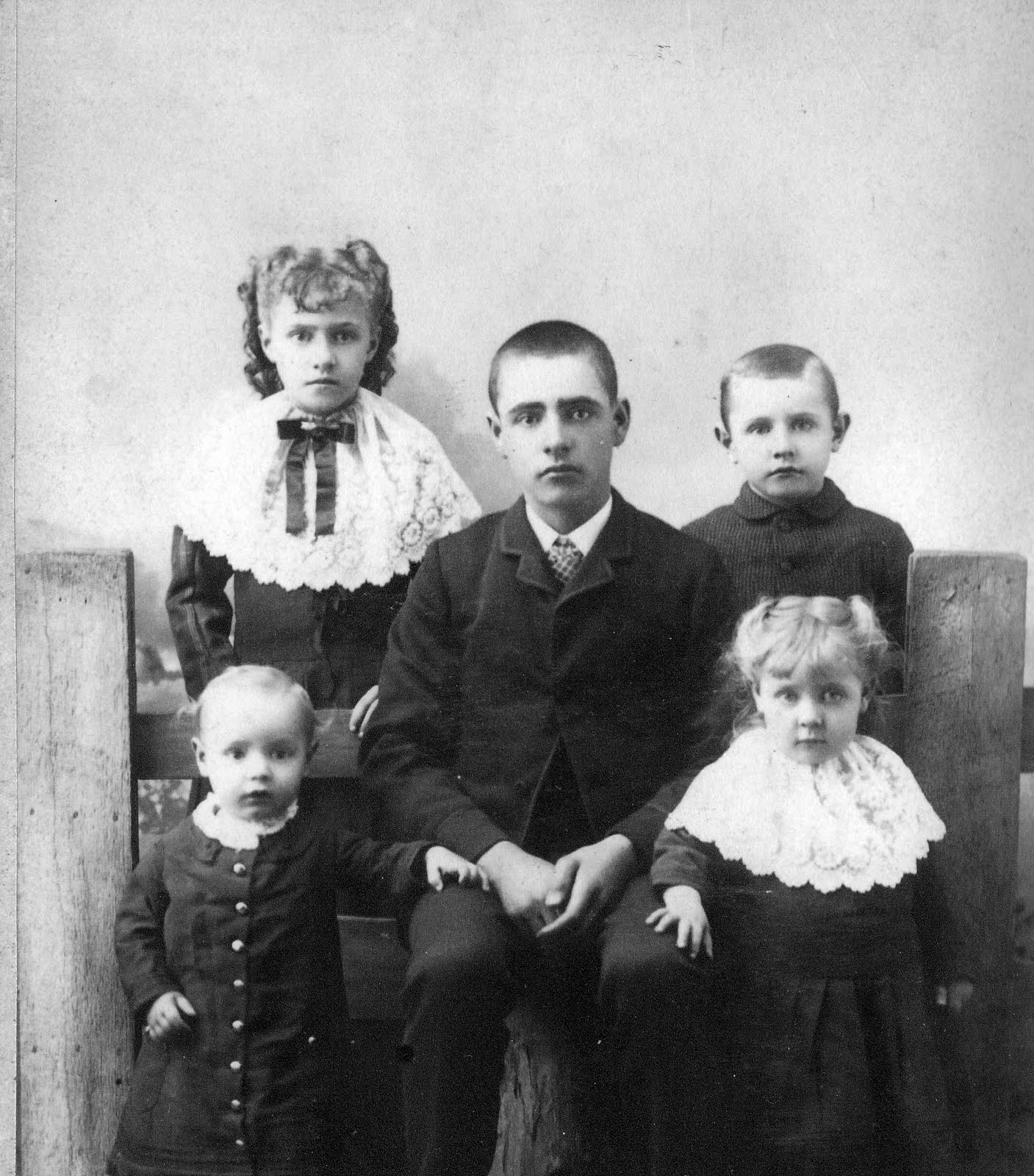
There's nothing like tromping through cemeteries in October. On our way up to Eaton County, my Mom called her cousin Richard and he met us at our first stop, Riverside Cemetery in Bellevue. He brought this picture, which we hadn't ever seen. These are the children of my 2nd great grandparents, Truman Uri Bradley and Sarah Blackmer. My Great Grandfather, Verner James, is the younger boy in the top right corner. The oldest boy is Emmon, the oldest girl (top left) is Lois Anna. The little boy (lower left) is Milton T.U. and the youngest daughter (lower right) is Hazel Amelia Bradley. Richard says there is a description on the back of the original and he'll let us know... but I would guess this to have been taken about 1888, the youngest about 2 years old and the oldest, 17.


It started raining, got dark and windy for a short time, and then.. the rainbow! Even background music (Michigan State Fight Song!), provided by the Bellevue Middle School band, practicing just behind those trees.

My grandparents, Burlyn T. and Gertrude Crain Bradley are buried here.

Then, we headed up to Spaulding Cemetery. We were last there in 2001, and I was sad to see that my 3rd great grandparents' grave stones had fallen.


James Dickinson and Tirzah Lankton Bradley

Both of them, right next to each other. The others are intact, though.

Richard's wife (Ponja) called and wanted to meet for lunch. Her lunch break was 11:45 in Olivet. We weren't paying attention to the time! Richard had to call her and say we'd be a little late, ha.

So we ran over to Olivet and met her at the Eagles Nest Cafe on Main St. Good food and good company. She grabbed the "Regulars" table (table of knowledge, according to Richard) and several others joined us. It was one of those places where everyone knows your name.

At the cemetery, Richard saw familiar names since he lives there. He's says, "Oh, I know some O'dell's." I told him they were probably all his cousins. He was surprised!

We then went down the street to the Olivet City Cemetery where we have some family. Ira Dickinson Bradley (oldest son of James) and his family is buried there.

Richard's wife and son are also buried there. He went home from there. It was really fun to see him.

We wanted to get back and finish at Spaulding, but we went up to West Carmel first. Last time we were there, we couldn't find James' daughter, Mary H. Bradley Brooks Stewart.

She's the one who spent 18 years in prison for killing her husband, Simeon Brooks. She was pardoned, and married David Stewart. I felt bad about this grave site, too.

Mary's young daughter was ill and died. Then her husband got deathly ill and died within the same month. The woman must have been beside herself. Apparently, she was worried that maybe she gave him too much medicine and told somebody that. That person then reported her for murder. And it only got worse from there.

Her second husband is buried with his first wife, and Mary's grave is right next to that. It just says "Mary H."

Sarah Blackmer Bradley's parents, James and Mary Ann Blackmer, and her siblings are also buried there.

When we left West Carmel, we wanted to drive by the old farm. It's right on 5 Point Hwy, just east of Lacey Lake Rd.

It was James D. Bradley's farm, left to Truman U, then Verner James Bradley. It was in the same family for over 100 years. When we saw it in 2001, it seemed in pretty bad shape. We didn't stop, but sometime we will. Now, in 2010, the outbuilding are gone and the farm house has been restored. It looks real nice!
We ended our day back at Spaulding. Since our last trip, we've discovered that James' niece was probably Lury Ann Woolcott who married Sylvester Day. They are all buried there, too, along with some other "Woolcutt's" that I need to check out.
Never Ending...

Nov 1, 2009

Back to James Dickinson Bradley

Sometimes you just have to set the dead ends aside for awhile, and go back with "fresh eyes". So... we've been studying James again.


There are some things that we know for sure:
  • From his tombstone, we know he was born Sept. 15, 1797.
  • From the 1850 census, he reported being born in MA.
  • We know he was married to Tirzah H. Lankton on June 5th, 1820 and they had 10 Children, at least 8 of whom were born in Whitestown, Oneida Co., N.Y.
Now here's a theory:
  • James D. could have been born in West Springfield MA to Nathaniel Bradley. The repeat of names and locations make this logical to me.
  • Nathaniel's parents were James and Jemima (Bishop) Bradley. I can't find anything about Nathaniel's marriage or children.
  • There is a Nathaniel at West Springfield MA in 1800. Here's where it starts getting confusing. Also in West Springfield is Cornelius Woolcott, who married Jemima Bradley. This Jemima would be the right age to be a daughter of Nathaniel (and would be named for Nathaniel's mother).
  • The next I find Nathaniel is 1820 in Whitestown, Oneida Co., NY, and within a few lines is Cornelius Woolcott.
  • There is a Nathaniel Bradley, Whitestown, in the report of rejected Revolutionary War Pensions. He did not serve 6 mos. (in CT)
  • No James D. Bradley in Whitestown in 1820 (more on that later)
  • 1830, James D Bradley is in Whitestown, just a few lines from Nathaniel and Cornelius Woolcott.
  • James D, Nathaniel and Cornelius and Jemima (Bradley) Woolcott still at Whitestown in 1840, all on the same census page.
One problem I have with this theory is that James didn't name any of his son's Nathaniel. However, he probably had older brothers (according to the 1800 census), so maybe it was already "taken". It would be so helpful if I found out who Nathanial was married to. It seems like there had to be the Dickinson name somewhere. Working on it though!

We found this info interesting from a Google Books search.

Mr Day is spoken of by his friends and neighbors as a man whom to know is to 
honor and esteem; a man of integrity and solid worth. On the 2nd day of 
September, 1840, he was married to Lura Ann Woolcott, daughter of Cornelius 
and Jemima (Bradley) Woolcott. She was born Oneida Co. N.Y., July 17, 1818. 
There were born to them Climena A., Oct 29,1842; Cornelius A., Aug 14, 1844; 
Curtis A., Feb 14, 1846; and Clark, Feb 18, 1849, died March 5 1849. 
Mrs Day died Feb 22, 1849.

So it looks like they all went to Eaton County Michigan.
I couldn't find Nathaniel after 1840, though. He and his wife were both in their 90's

I'll add more on James' marriage and the Lankton's later. I'm confusing myself here so far...

Nov 9, 2008

Descendants of James Dickinson Bradley

1 James Dickinson Bradley b: September 15, 1797
..+Tirzah Lankton b: May 17, 1801 in CT
........2 Ira Dickinson Bradley b: February 12, 1821
........2 Hannah H Bradley b: March 17, 1822
........2 George A. Bradley b: May 09, 1825
........2 Truman U. Bradley b: August 13, 1827
........2 Joseph Otis Bradley b: December 15, 1829
........2 Mary H. Bradley b: April 24, 1832
........2 Truman Uri Bradley b: March 28, 1834 in Oneida Co., New York
............+Mary Abigail Campbell b: January 23, 1845
...................3 Rhoda Ann Bradley b: May 25, 1862
........*2nd Wife of Truman Uri Bradley:
............+Sarah Blackmer b: March 12, 1851 in Canada
...................3 Emmon Albertis Bradley b: December 26, 1871
...................3 Floy Arena Bradley b: July 06, 1875
...................3 Lois Anna Bradley b: December 19, 1877
...................3 Verner James Bradley b: November 29, 1880 in Eaton Co., Michigan
.......................+Myrtle Talbot b: March 31, 1881
.............................4 Gerald Cole Bradley b: January 22, 1904
.............................4 Burlyn Truman Bradley b: March 24, 1908 in Eaton Co., MI
.................................+Gertrude Mary Crain b: March 08, 1910 in Escanaba MI
.............................4 Ella Maxine Bradley b: January 28, 1911
.............................4 Sara Bethel Bradley b: January 15, 1914
...................3 Hazel Amelia Bradley b: October 31, 1884
...................3 Milton T.U. Bradley b: June 01, 1886
........2 Lury Ann Bradley b: February 14, 1837
........2 Sarah Elvira Bradley b: May 07, 1840
........2 Emma Varnera Bradley b: October 13, 1845

Aug 6, 2008

Skeletons in the Attic

Mary Bradley Brooks was an aunt of mine. It's hard to follow the story as you'll see once you try to read her letters! She was convicted of murdering her husband but later pardoned by the Governor of Michigan. It's one of those stories that makes me think of how life changes whole generations later. Just the fact that she mentions in one letter that she wants to move to "newbrasky" with the family made me wonder if that's why they didn't go? My GGG Grandfather (father of Mary) died a short time after her conviction. What if she hadn't been accused and convicted, and they left Michigan for Nebraska? Surely my GG Grandfather would never have married my GG Grandmother and, well.... you can see how this goes.

The trial and sentence for life of Mary Brooks of Kalamo

Eaton County Genealogy Library
May 21, 2002
Eaton County Republican Newspaper - February. 14, 1857

The letters written by Mary Brooks to Watson P. Woodruff in the Spring of 1856, when she first learned that the body of her husband was to be exhumed for examination.

The trial and sentence for life of Mary Brooks of Kalamo, for the murder of her husband, Simeon Brooks, on or about the 15th of March last, is doubtless fresh in the minds of all of our readers. Her trial was on the 5th and 6th of May last. It will be recollected that Watson P. Woodruff testified that the prisoner had at four different times requested him to dig up and secrete the body of her husband. He also admitted that he had received two letters from her, urging him to undertake the concealment of the body. He stated that he told her he hated to do it.


Whether the following letters are those he referred to in his testimony, we know not. But they are evidently letters written to him by Mrs. Brooks, at that time and upon the subject. They were furnished us for publication by Ira Pearl of Kalamo, the man who first made complaint of the murder of Simeon Brooks. We have had them in our possession several weeks, undecided in regard to giving them publicity. Two of the brothers of the unfortunate woman have seen them, and have given their consent to their publication. There is, we think, no reason to doubt the genuineness of the letters. The manner in which they came into the hands of Mr. Pearl we do not feel at liberty to state. To our mind the letters contain strong evidence that Mary Brooks was alone implicated in the commission of the murder.


The letters are written upon three half sheets of letter paper; two of them evidently forming the first letter. We give them verbatim et literatim without taking the usual liberty of correcting the orthography. We wish to give them precisely as they were written.

Sheet 1st
"Watson the county is a going to take Sim up so pres swift told me last night he come from feroes and stoped and told me they aint agoing to do any more about it till he is examined and then they are agoing to take us both up and now i tell you Watson you must talk with Treu about it right of and try to have him help you dig him up for if you Ont it will be to late now you must not deny this time if you want me saved and that is all that will do it that is so now i pray Ont wait any longer grant me my last request i beg on you

(PAGE 2)
for if you Ont i shall have to go to state prison now if you cant get Treu you must do it for i cant stand it so now talk with Treu right off and dig him up right off Ont wait any longer for it will be to late. i feel if it was you and i could almost give my life to save you and that is all that will save me any how now do it Watson wont you tell Treu if he has got much feelings for a sister to save her he would be willing now do it and go west with him from where. from Hare is not Ont wait for it in a getting to late i place my life on you almost and that is all that will save it now Ont deny my last request.
M.C."

(Sheet 2d)
This half sheet was torn from the one upon which the preceding was written. It is badly spotted, soiled and torn, and upon one side it is directed to Watson P. Woodruff.


"i want you to read the other first tru has promised me he would bring these you and have a talk with you now i want you to burn these up as soon you can after you read them for my sake i am just as sure that was pison in that medicine as can be and if he is dug up and examined states prison is my doom the county is a going to do it pres says that is so now i want you to have
courage and do it i think you can get tru to help you if you have courage yourself do it to save me by all means i think if tru cares much for me he will help for die i shall if it aint done that is so do it right off to night now watson it wont take you a grate while now start and then back out
now tell not to say any thing about these letters and dona you but take a mach and burn them up now save my life while you can for i know if you dont do that i shall get clear taint possible for me to and it will save trouble now remember my last words to you in this you will be sorry hereafter if you dont grant me my request now burn these up so that hereafter they wont make no fuss - M.A. Woodbury - Mary H. Brooks.

do grant i pray my requst in these letters to night now dont back out for that is all that will save me."


(Sheet 3d)
This is also a half-sheet of letter paper of the same color of the sheets upon which the foregoing was written. It was cut from the remainder of the sheet with a pair of scissors, and has been sealed in the form of a letter. It bears no date but it was evidently written after the foregoing.


"watson for the land sake if you have got any mercy on me or want to relieve my trouble do dig him up night off to night i told father jo and tru abaout that medicine and they said it would ruen me and send me to states prison in spite of all they could do if he was

(PAGE 3)
dug up and examined dont say any thing to father about the medcine i told tru that to dig him up and take him away from there was all that would save me and tru said he hated to do any such thing i shall die if you dont do it you will find tools righ at the old house by the fore dore now watson if you want to clear me do it to night for dick is commencing upon me and i dont know what to do father and tru says they shall go to newbrasky as soon as this fus is over now if you want to clear me so i can go dont deny me this last call leave your team and go and talk with tru but dont tell him that i have wrote to you for mercy sake burn this up as soon as you get a chance now watson you do as i want you to wont you dont back out for that is all that will save me and i told tru so now dont fret it off any longer

from your best friend Mary H. Brooks now do it"

Upon the outside of this sheet is written: "you nednet say any thing to tru about it"


Charlotte Tribune
Feb. 18, 1870
Local News

Mrs. Mary Books, convicted of murder in the county June 5, 1856, and sentenced to State Prison for life, has been pardoned by Gov. Baldwin.

Feb 29, 2008

Revolutionary Soldiers Resident Or Dying in Onondaga County, N. Y. With Supplementary List of Possible Veterans, Based on a Pension List of Franklin H

JAMES LANKTON This pioneer is reported as certainly a soldier though his name does not appear He was from Harwinton Ct where he married Tirzah Catlin who died in 1799 He bought land in Pompey about 1806 and there he married Mrs Sophia Butler Levi Clark became his administrator Oct 28 1835 "
This is a big break through for me! I never knew that this family was in Onondaga Co., until I happened to find this in Google Books. "Mrs. Sophia Butler" was the sister of Tirzah Catlin Lankton. James must have gone to Pompey earlier than 1806 because their daughter was born May 17, 1801. Which means........ I've been looking in the wrong place all this time!!!! Oh well, back to my reading.